Interviews
Written By:
David Welsh
Photos By:
Katherine Lu
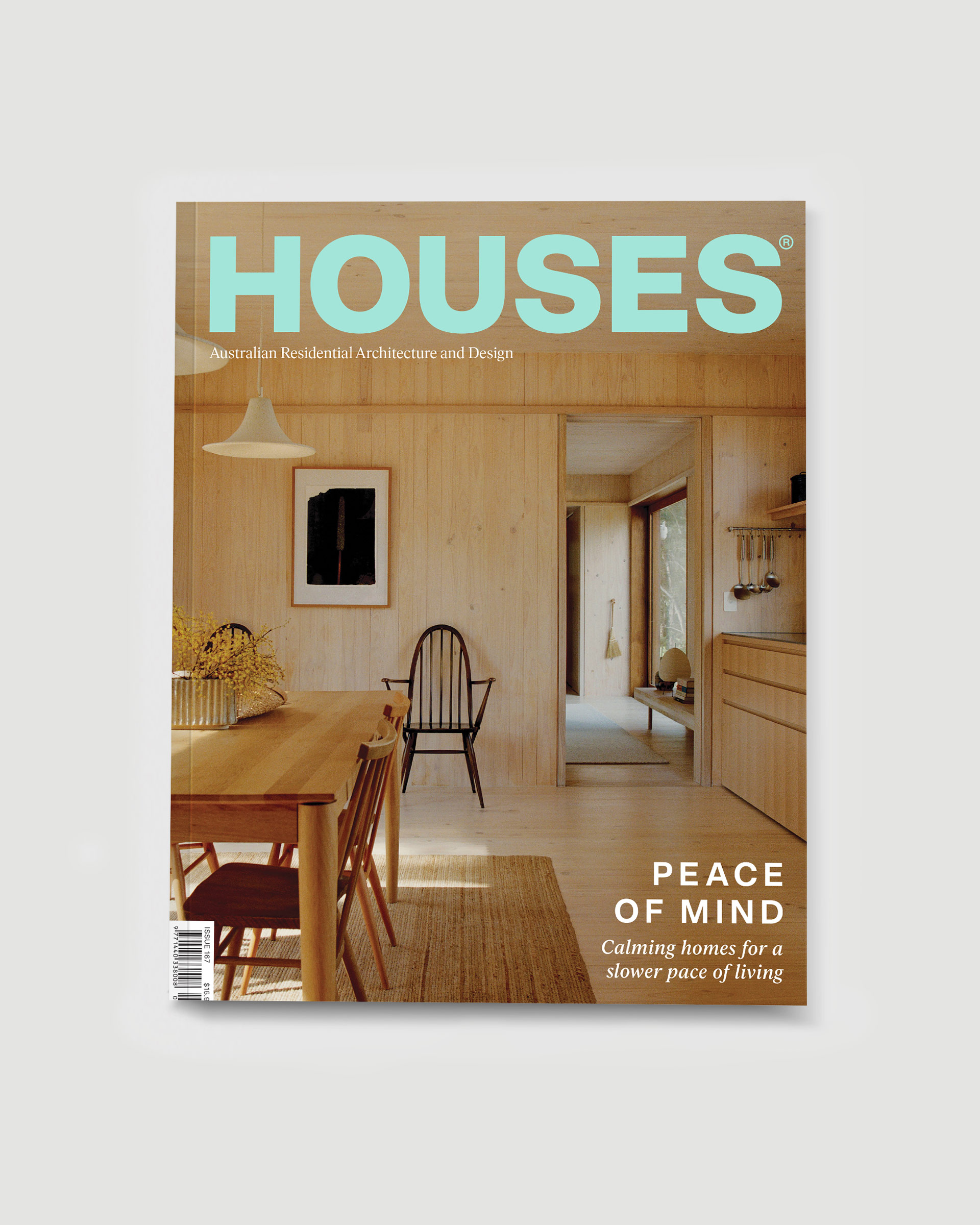

Solid, Simple, Beautiful: A TRIAS Profile in Houses Magazine
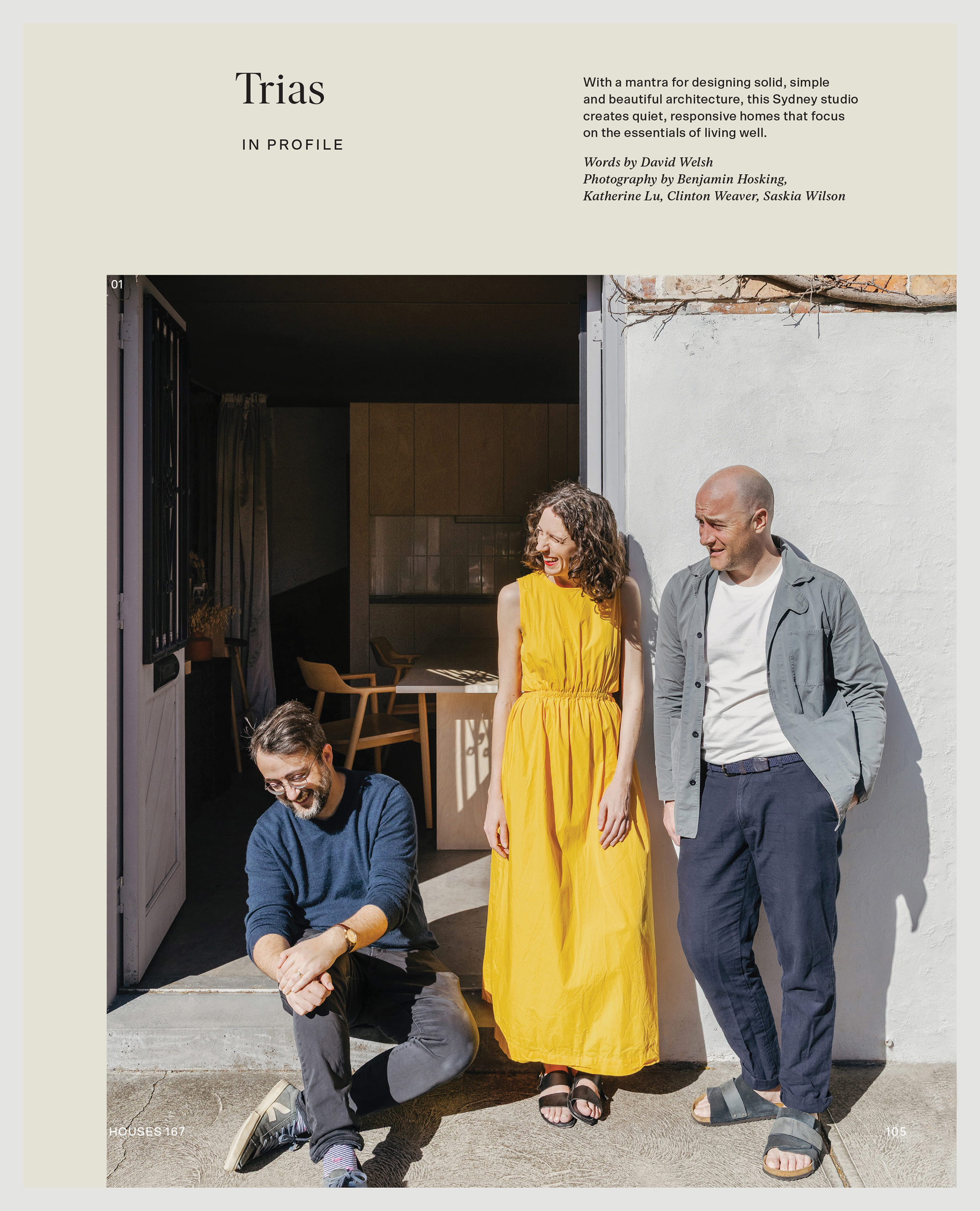
This practice profile was published in Houses magazine and written by David Welsh of Welsh + Major. It was a pleasure to speak with David about the ideas, values and experiences that helped shape Trias and continue to define our trajectory.
Originally published in Houses magazine, Issue [167/2025]. Reproduced with permission.
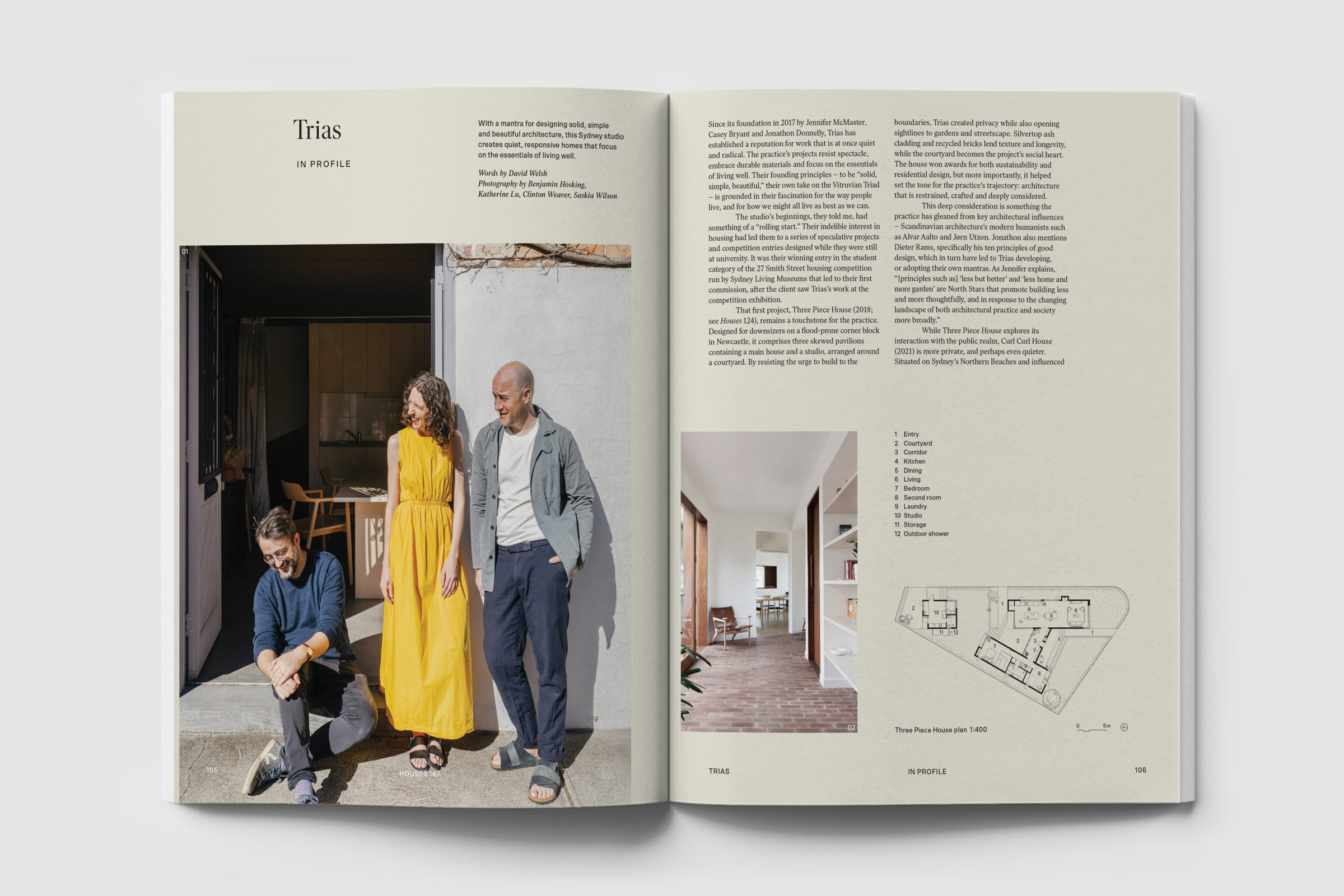
Since its foundation in 2017 by Jennifer McMaster, Casey Bryant and Jonathon Donnelly, Trias has established a reputation for work that is at once quiet and radical. The practice’s projects resist spectacle, embrace durable materials and focus on the essentials of living well. Their founding principles – to be “solid, simple, beautiful,” their own take on the Vitruvian Triad – is grounded in their fascination for the way people live, and for how we might all live as best as we can.
The studio’s beginnings, they told me, had something of a “rolling start.” Their indelible interest in housing had led them to a series of speculative projects and competition entries designed while they were still at university. It was their winning entry in the student category of the 27 Smith Street housing competition run by Sydney Living Museums that led to their first commission, after the client saw Trias’s work at the competition exhibition.
That first project, Three Piece House (2018; see Houses 124), remains a touchstone for the practice. Designed for downsizers on a flood-prone corner block in Newcastle, it comprises three skewed pavilions containing a main house and a studio, arranged around a courtyard. By resisting the urge to build to the boundaries, Trias created privacy while also opening sightlines to gardens and streetscape. Silvertop ash cladding and recycled bricks lend texture and longevity, while the courtyard becomes the project’s social heart. The house won awards for both sustainability and residential design, but more importantly, it helped set the tone for the practice’s trajectory: architecture that is restrained, crafted and deeply considered.
This deep consideration is something the practice has gleaned from key architectural influences – Scandinavian architecture’s modern humanists such as Alvar Aalto and Jørn Utzon. Jonathon also mentions Dieter Rams, specifically his ten principles of good design, which in turn have led to Trias developing, or adopting their own mantras. As Jennifer explains, “[principles such as] ‘less but better’ and ‘less home and more garden’ are North Stars that promote building less and more thoughtfully, and in response to the changing landscape of both architectural practice and society more broadly.”
While Three Piece House explores its interaction with the public realm, Curl Curl House (2021) is more private, and perhaps even quieter. Situated on Sydney’s Northern Beaches and influenced by the walled courtyard houses of Mexico City, this new family home reads as a pair of brick volumes joined by a light-filled pavilion. To the street, it is solid and protective; to the garden, it opens with generosity.
The early design stages of Curl Curl House also prompted the practice to expand its approach to sustainable living. Jennifer explains how the clients “wanted a very solid home, to feel protected and safe, after a lifetime spent in flimsy rentals. Our line of enquiry became: how do we create a sustainable home that embraces having high thermal mass? This led to lots of exposed finishes paired with recycled timbers and a lush garden. We also focused on carbon neutral operations via a heat pump and solar, which runs the hot water, pool heating and reverse-cycle hydronics, which make the most of all the mass and bring thermal comfort year-round.”
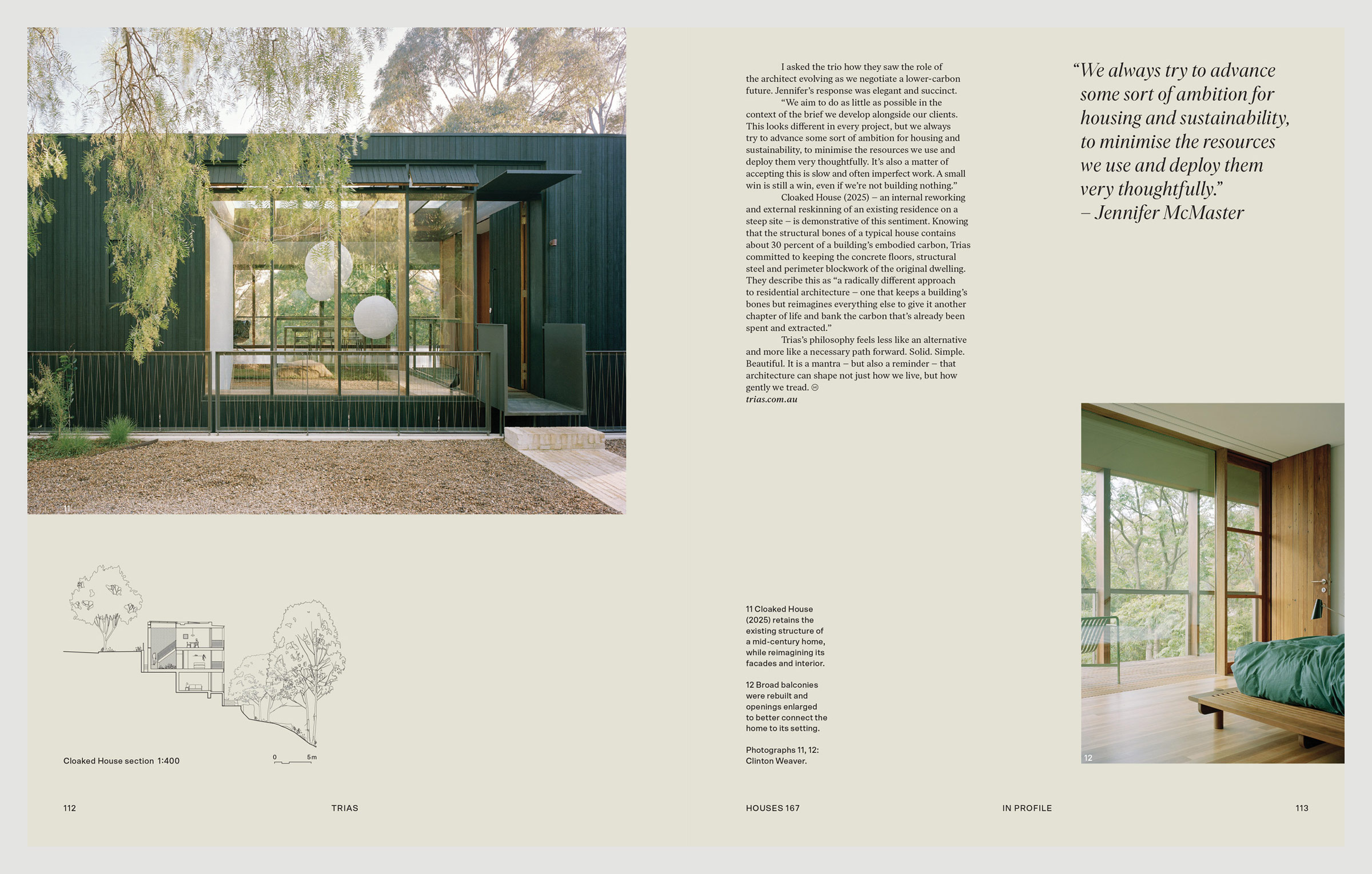
“We always try to advance some sort of ambition for housing and sustainability, to minimize the resources we use and deploy them very thoughtfully”


In 2019, the trio came to a fork in the road. That year saw the beginnings of Architects Declare – a network of architects committed to addressing the climate and biodiversity emergency – and the devastation caused by the bushfires of 2019–20. Embodied carbon became a more-discussed metric. Issues around climate and sustainability developed an immediacy and required more urgent attention than they had previously been given. Pursuing operational neutrality, scrutinising the size of the buildings that were being designed and built, and interrogating what those buildings were made of – already tenets in Trias’s approach – intensified. Jennifer says “sophisticated sustainability” became another North Star to follow: a drive to establish responsible ways of practising architecture and to promote housing that is well-designed but not excessive.
In Draped House (2022; see Houses 157), conversations about sustainability pivoted to investigate how much we should be building. Draped House, at just 129 square metres, was built for a young couple. The house takes its name from a sweeping, curved roof that stretches over the plan like fabric, sheltering spaces that flow beneath it. A central scribbly gum tree anchors the design, around which the architects arranged living spaces that feel simult-aneously compact and expansive.
By this time, Trias had been collaborating with FabPreFab on a modular housing suite known as Minima for a number of years. One of the realised projects is Practice Ground (2024), a customised iteration of the prefabricated Minima model. Set on Wiradjuri Country at the edge of Wollemi National Park, the retreat is Trias’s most ambitious prefab project yet. The house was manufactured off-site and delivered in large components for assembly on site – a process that reduced build time, minimised waste and site disruption, and created material and energy efficiencies. While it benefits from the advantages of prefab efficiencies, the end result has a sophisticated quietness, warmth and sense of craft – qualities that are not often associated with a factory-assembled product.
I asked the trio how they saw the role of the architect evolving as we negotiate a lower-carbon future. Jennifer’s response was elegant and succinct.
“We aim to do as little as possible in the context of the brief we develop alongside our clients. This looks different in every project, but we always try to advance some sort of ambition for housing and sustainability, to minimise the resources we use and deploy them very thoughtfully. It’s also a matter of accepting this is slow and often imperfect work. A small win is still a win, even if we’re not building nothing.”
Cloaked House (2025) – an internal reworking and external reskinning of an existing residence on a steep site – is demonstrative of this sentiment. Knowing that the structural bones of a typical house contains about 30 percent of a building’s embodied carbon, Trias committed to keeping the concrete floors, structural steel and perimeter blockwork of the original dwelling. They describe this as “a radically different approach to residential architecture – one that keeps a building’s bones but reimagines everything else to give it another chapter of life and bank the carbon that’s already been spent and extracted.”
Trias’s philosophy feels less like an alternative and more like a necessary path forward. Solid. Simple. Beautiful. It is a mantra – but also a reminder – that architecture can shape not just how we live, but how gently we tread.

Interviews
Written By:
David Welsh
Photos By:
Katherine Lu
References
Peninsular pavilions: Three Piece House, https://architectureau.com/articles/three-piece-house/
Draped House by Trias, https://architectureau.com/articles/draped-house-by-trias/